
What Google's Changes Mean for AI Use in Business
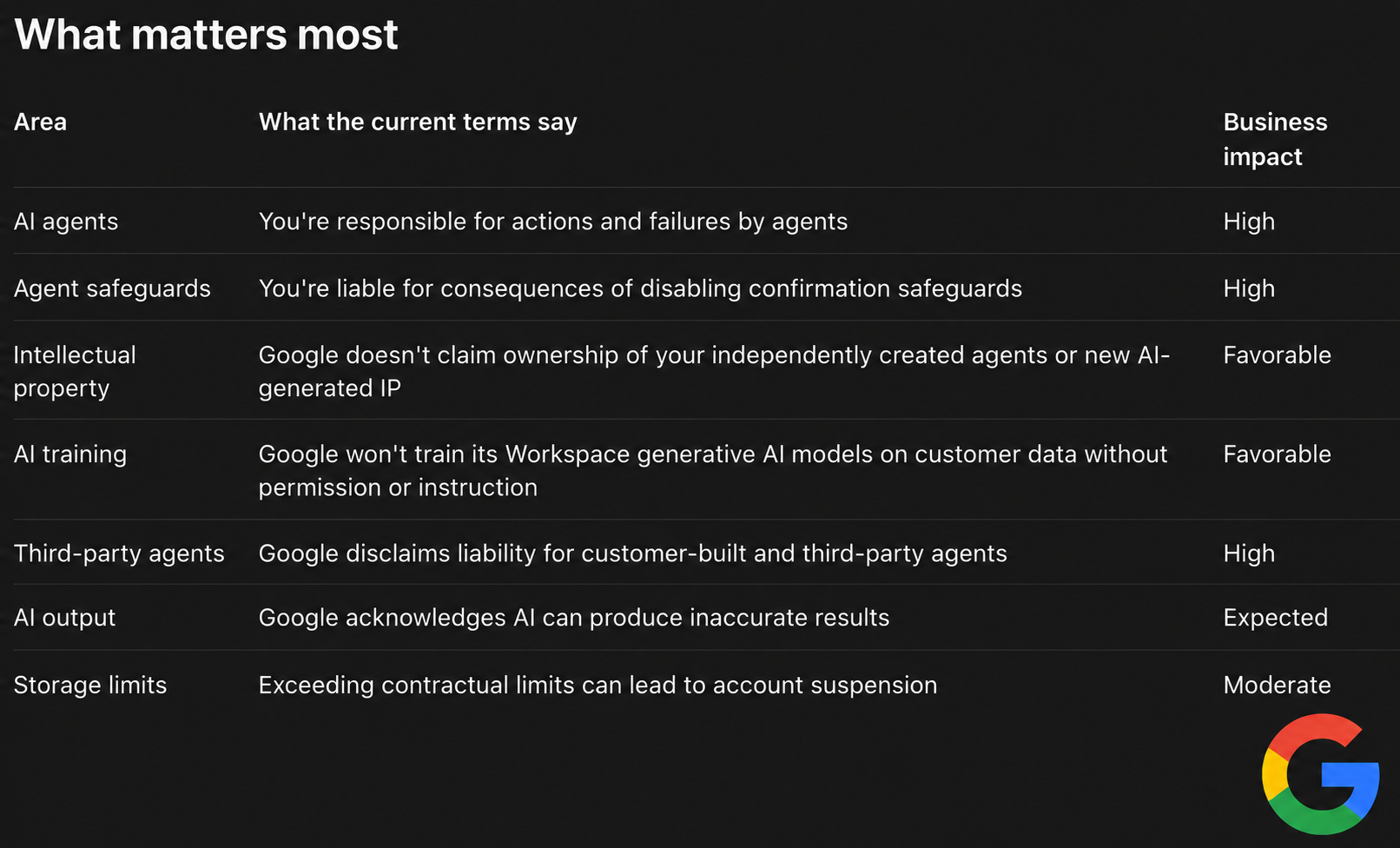
You already know that your actions, including delegation to someone else, bear responsibility in business. Now your liability is becoming more clear through policy. Google recently updated its Workspace Service Specific Terms, including provisions addressing AI agents, customer responsibility, and intellectual property.
You probably don't read the terms for your software tools every time they change. Changes to software terms and conditions barely register for a lot of people. But this update deserves your attention.
Google is acknowledging something important about where AI is heading: Action.
It's the very definition of an agent-- someone, or now something that takes action on your behalf, because you instructed it to do so. Human agents have contracts and legal documents outlining their liability and yours. But what about an AI agent, which is not a legal entity?
From AI Assistant to AI Employee
AI agents can perform actual business functions. They can respond to customers, organize information, update records, manage workflows, and coordinate with other systems. These are things you used to do exclusively.
Two scenarios worth considering: Imagine asking an AI assistant to draft an email to a customer. You review it, make any necessary changes, and send it. Now imagine an AI agent that identifies the customer, determines what needs to be communicated, writes the email, and sends it without your involvement.
Both use artificial intelligence. But the second is making decisions and taking actions on behalf of your business.
That distinction is at the heart of Google's updated terms.
The Responsibility Doesn't Transfer
Google's Workspace terms make clear that customers bear responsibility for the actions and omissions of AI agents operating on their behalf.
They also address what happens when customers disable or bypass safeguards designed to require human confirmation before certain actions occur.
Stated simply: delegating work to AI doesn't delegate accountability.
If an agent sends incorrect information to a customer, makes an unauthorized change, or fails to complete an important task, your business may still bear the consequences.
AI introduces a new dimension because these systems can exercise judgment and act with greater independence.
The lesson isn't that AI agents are too risky. The big "gotcha" though is speed. The work they will do for you happens at a speed that you can't match. That's the advantage and risk wrapped up together.
Autonomy needs to be accompanied by accountability.
There's Good News Too
Not everything in Google's terms is about liability. Two provisions are especially relevant to businesses investing in AI.
First, Google's Workspace terms continue to provide protections against using customer data to train its supporting generative AI models without permission or instruction.
Second, Google does not claim ownership of new intellectual property in AI-generated output merely because its services produced it. Its updated language also addresses ownership of customer-created agents. These are important distinctions.
Your company's customer relationships, operating procedures, institutional knowledge, and proprietary methods are valuable business assets. The new terms say that they remain yours.
But the broader direction is encouraging, and it should give you confidence rather than hesitation.
The Real Question Is How Much Authority You Give AI
What decisions and actions am I comfortable allowing AI to make on behalf of my business?
Deciding this is your first job and it's specific to you. What's your appetite for risk? How central is your desire for control?
An agent that organizes internal meeting notes doesn't require the same oversight as one that issues refunds, changes financial records, or sends binding commitments to customers. The appropriate level of supervision depends on the consequences of getting something wrong.
That means thinking about AI much like we think about delegating work to people.
We establish responsibilities, define authority, write procedures, and we verify that the work is being done correctly. Interestingly, we also pay more for people who assume the responsibility for risky actions.
The objective is to make the agent maximally useful to you, and minimally hazardous.
This Is a Sign of Maturity, Not a Warning to Retreat
Google's updated terms reflect a broader transition in business technology. AI is moving beyond experimentation and becoming part of how companies actually operate.
That means questions about ownership, accountability, permissions, and operational risk are becoming more important. For small businesses, this is an opportunity.
We can use AI to accomplish work that previously required additional staff, outside vendors, or hours of our own time. We can build systems around the unique knowledge and processes that make our businesses valuable.
But we need to approach those systems with the same seriousness we bring to every other part of running a company.
AI doesn't have to be perfect to be valuable. It has to be useful, appropriately supervised, and accountable to the business it serves.
Imperia Forged helps businesses understand and apply artificial intelligence to real operational challenges.
Source: Google Workspace Service Specific Terms
This article is a business interpretation of selected contractual provisions, not legal advice.